
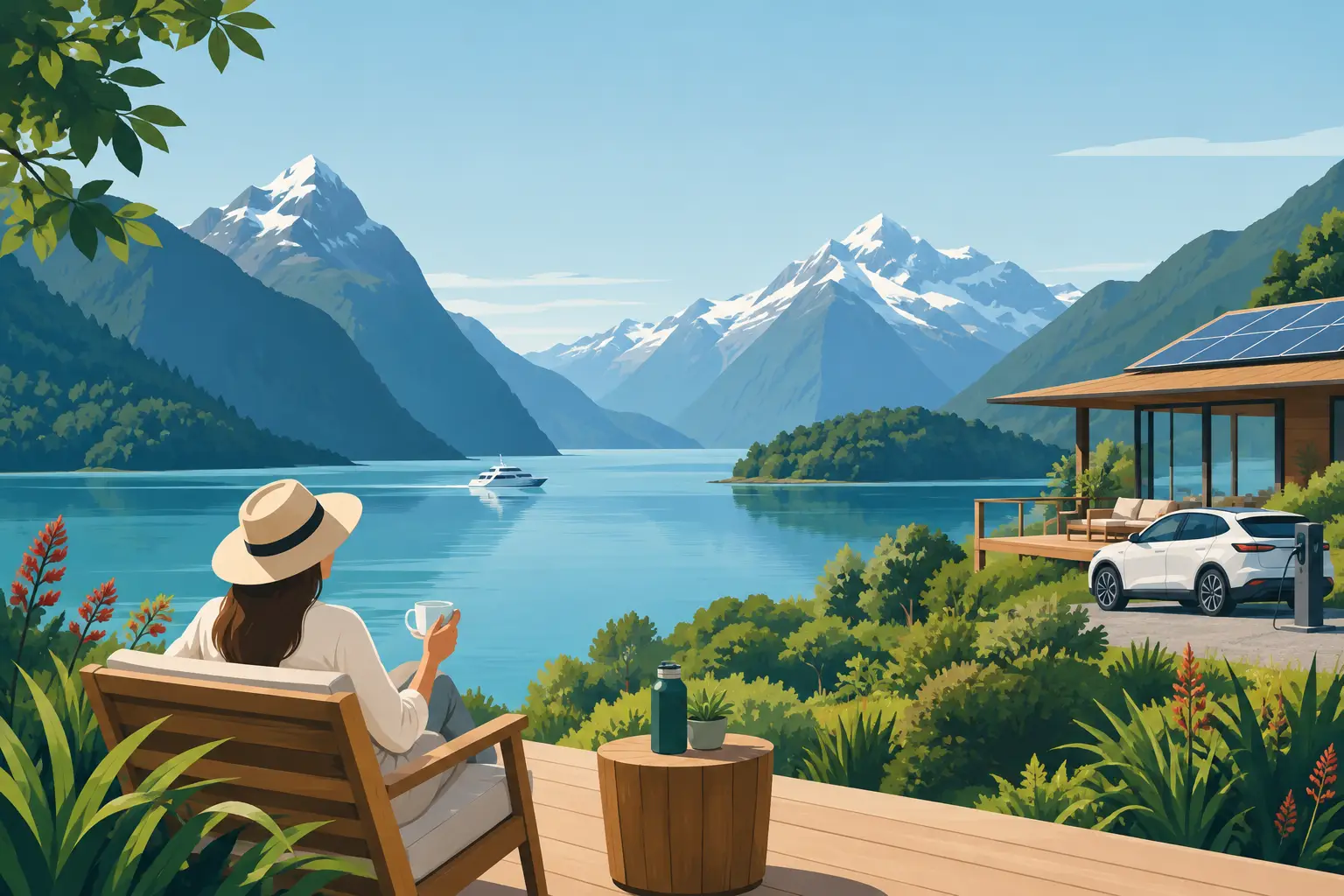
A private arrival at Auckland Airport need not mean an extravagant footprint. Sustainable luxury travel is about making considered decisions without giving up the privacy, comfort, timing and personal service that make a journey feel exceptional. For discerning visitors to New Zealand, that often begins with how efficiently the ground journey is planned.
Luxury and sustainability are sometimes presented as opposites: one focused on indulgence, the other on restraint. In practice, the strongest travel experiences combine both. A well-timed private transfer, a vehicle suited to the number of passengers, a thoughtfully paced itinerary and spending with local operators can reduce unnecessary waste while making every part of a holiday or business visit more enjoyable.
What sustainable luxury travel really looks like
Sustainability is not a single booking choice or a label on a hotel website. It is the cumulative effect of transport, accommodation, food, activities and the way travellers move through a destination. New Zealand’s landscapes are a central part of its appeal, from the Waitākere Ranges and Waiheke Island to Rotorua, Taupō and the South Island’s alpine regions. Protecting the quality of those places calls for travel that is attentive rather than extractive.
For luxury travellers, this means choosing quality over excess. It can mean staying longer in fewer places instead of taking several short internal flights, travelling privately with family or colleagues rather than arranging multiple vehicles, and selecting experiences that keep more value within the communities hosting them. Comfort remains the priority, but waste and unnecessary movement are no longer treated as part of the premium experience.
There is also a practical distinction between sustainable claims and measurable action. No vehicle journey is impact-free, and a chauffeur service should not imply otherwise. The more meaningful question is whether the vehicle, route and schedule are appropriate for the journey. A Mercedes V-Class transporting a family of six with luggage may be a more sensible choice than two separate cars. A Mercedes Sprinter for a conference party can reduce the number of individual airport transfers while giving every guest space to travel comfortably.
Start with efficient airport and intercity transport
Ground transport is one of the easiest areas to improve because it can be planned in advance. An airport collection arranged around the actual flight schedule avoids guests waiting in a queue for several taxis, taking wrong turns in an unfamiliar city or booking duplicate rides after a delayed arrival. For executives, families and VIP guests, it also protects the privacy and punctuality that private travel is intended to provide.
The best vehicle is not always the smallest one. It depends on passenger numbers, luggage, mobility needs and the purpose of the trip. An executive travelling alone may need a quiet sedan for calls between Auckland Airport and the CBD. A multi-generational family heading to a lodge may be better served by a people mover with enough room for everyone and their bags. Event organisers can reduce unnecessary journeys by grouping arrivals according to flight banks, hotel locations and venue timings.
Route planning matters as well. A professional chauffeur can account for peak-hour traffic, cruise schedules, roadworks and realistic comfort stops on longer journeys. This reduces avoidable kilometres and helps guests arrive on time without rushing. When a full-day itinerary is required, combining nearby experiences into one well-organised route is generally more considerate than repeatedly returning to the city between activities.
Brightlane supports this approach through pre-booked private transport, free Meet & Greet service and vehicle options for individual travellers, families and larger groups. The value is not simply a premium vehicle. It is having a journey managed properly from the outset, with the right capacity and schedule in place.
Ask the right questions before booking
A sustainable decision does not have to involve complicated calculations. Ask whether passengers travelling at similar times can share one private vehicle, whether the itinerary allows for one longer stay rather than repeated transfers, and whether a larger vehicle will prevent the need for a second car. For corporate travel coordinators, these choices can also simplify invoices, guest communications and event-day logistics.
If an itinerary includes Auckland, Hobbiton, Waitomo and Rotorua, consider travelling in one direction with overnight stays instead of treating each destination as a separate day trip from the city. That approach creates a calmer holiday, gives guests more time in each region and makes better use of the driving involved.
Choose experiences that benefit the places you visit
The environmental side of travel receives most of the attention, yet the social and economic side matters just as much. Luxury travellers can make a positive contribution by choosing locally owned accommodation, regional guides, independent wineries, producers and cultural experiences delivered with care and permission.
New Zealand is not a backdrop for a checklist. A meaningful itinerary leaves room to understand the place: the food grown there, the stories held by mana whenua, the seasonal conditions affecting the landscape and the work required to look after it. A private wine tour on Waiheke, for example, is more rewarding when it is paced around the vineyards and people behind the wines, rather than fitted into an unrealistic timetable.
Look for operators that are clear about their practices. They should be able to explain how they manage waste, respect sensitive environments, employ local people or support conservation. Broad statements about being green are less useful than specific information about what happens on the ground. It is reasonable to ask questions, especially when arranging a high-value holiday, corporate retreat or hosted VIP programme.
Let quality replace quantity
A premium New Zealand holiday does not need a packed schedule to feel memorable. In fact, attempting to cover Auckland, Queenstown, Milford Sound, Rotorua, Wellington and the Bay of Islands in a few days can create a procession of check-ins, flights and hurried photos. It also leaves little time for the moments guests usually remember: a long lunch, a quiet coastal walk, a conversation with a guide or an unplanned view from the road.
A slower itinerary can still be highly tailored. It may include private chauffeur hire, flexible collection times, preferred dining reservations and room for weather changes. The difference is that each element serves the journey instead of filling the calendar.
Make luxury more considerate during the stay
Small decisions have greater credibility when they are consistent. Reusing towels when appropriate, carrying a refillable bottle, avoiding single-use items and respecting marked tracks are straightforward ways to reduce pressure on the places being visited. For visitors travelling through rural areas, it also means following biosecurity guidance carefully. New Zealand’s ecosystems are unusually vulnerable to pests and disease, so cleaning footwear and outdoor equipment is a practical courtesy, not a minor detail.
Dining choices can be equally meaningful. Seasonal menus, regional produce and restaurants that know where their ingredients come from often offer a stronger sense of place than imported luxury for its own sake. The same applies to gifts and purchases. A well-made item from a local artisan has more lasting value than a collection of disposable souvenirs.
Business travellers and event planners have a particular opportunity to set the standard. A conference programme can coordinate airport arrivals, use one quality group vehicle for venue movements, choose reusable event materials and schedule enough time for guests to travel safely. These measures improve the guest experience as much as they reduce duplication. No one considers a fragmented transport plan or a rushed transfer to be a mark of luxury.
Sustainable luxury travel is a matter of judgement
There is no perfect travel itinerary, particularly for visitors arriving from overseas. Long-haul flights carry a significant impact, and thoughtful choices on the ground do not erase it. They do, however, shape what happens next: how much transport is duplicated, where visitor spending goes, how respectfully guests engage with local places and whether the holiday is designed for depth rather than consumption.
The most sophisticated approach is not about sacrificing comfort or performing sustainability. It is about travelling with purpose. Choose the right vehicle, allow enough time, stay curious about the people and landscapes around you, and let considered service make the journey feel easier at every stage.