
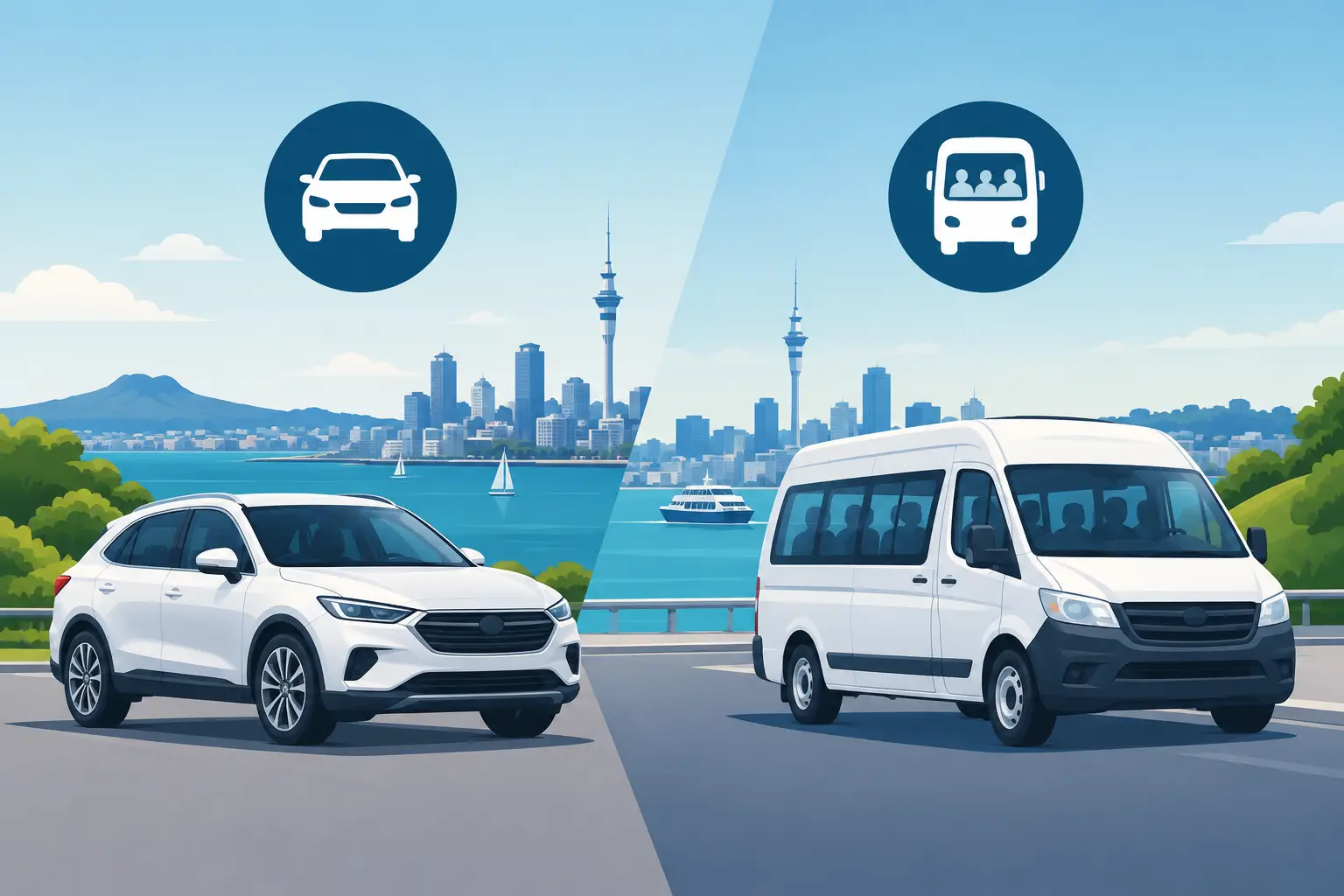
Landing at Auckland Airport after a long-haul flight is not the moment to negotiate luggage, wait for other passengers or wonder whether your transport will arrive on time. The choice between a private car versus shared shuttle shapes the first and last part of your New Zealand journey. Both can serve a purpose, but they deliver very different levels of privacy, flexibility and certainty.
For business travellers, families, VIP guests and anyone working to a fixed schedule, the decision is often less about the headline fare and more about the time, comfort and coordination behind it.
Private Car Versus Shared Shuttle: What Changes?
A shared shuttle normally carries unrelated passengers travelling to different addresses. It may leave once enough passengers are aboard, and the driver will usually follow a route determined by the drop-off order. This can be a sensible option for a solo traveller with a flexible schedule, light luggage and no need for privacy.
A private car is reserved solely for your party. Your chauffeur meets you at the agreed time, assists with luggage and takes you directly to your hotel, home, office, cruise terminal or next destination. There are no additional collections, no detours for other passengers and no need to adjust your plans around someone else’s flight or address.
That distinction matters particularly in Auckland. Airport traffic, peak-hour congestion and the distance between accommodation areas can all affect journey times. A direct, pre-booked transfer gives you a clearer timetable from the moment you leave the terminal.
Timing Is Often the Deciding Factor
The most visible difference between a private car and a shared shuttle is control over time. With a shared service, even a well-run journey can involve waiting for other arrivals, loading multiple sets of luggage and making several stops. A 30-minute direct airport transfer can become considerably longer when passengers are travelling to different parts of the city.
Private transport is arranged around your itinerary. For an arrival, this means a chauffeur can be ready following your flight-related waiting period, rather than operating to a general departure cycle. For a departure, collection is scheduled to allow for your check-in requirements, traffic conditions and preferred level of contingency.
This is especially valuable when you are travelling for a board meeting, conference, wedding, cruise embarkation or international connection. Missing a planned moment because a shared vehicle is delayed by another passenger is rarely a worthwhile saving.
For early-morning departures, private transport also removes an awkward uncertainty. Rather than hoping a multi-stop route runs to plan before dawn, your vehicle arrives for your party at the agreed address.
Privacy, Comfort and Arrival Standards
A shared shuttle is a practical mode of transport, but it is a public travel environment. You may share close quarters with strangers, field work calls beside other passengers and manage bags around a vehicle configured for multiple drop-offs. After a 20-hour journey, that may not be the experience you want.
In a private Mercedes-Benz executive sedan, V-Class people mover or Sprinter minibus, the cabin belongs to your group. You can make a confidential call, discuss the day ahead, relax with your family or simply enjoy quiet after your flight. Onboard WiFi can be useful for executives catching up on messages before a meeting or visitors confirming accommodation and plans.
Vehicle choice also matters. An executive arriving alone may prefer a refined sedan, while a family with prams, sports equipment and several suitcases may be far better served by a V-Class. Larger delegations, wedding parties and corporate groups can travel together in a premium minibus rather than splitting into several smaller vehicles.
The value is not only in the vehicle. It is in a professionally presented chauffeur, careful luggage handling and an arrival experience that feels considered from the terminal to the door.
The Real Cost Comparison
Shared shuttles are often priced per passenger, while private transfers are priced per vehicle or journey. For one budget-conscious traveller, the shared option can appear less expensive. For two, four or six passengers, the calculation changes quickly.
A family or small business group should compare the total shared-shuttle fare against the cost of one private vehicle, not the individual fare alone. Then account for practicalities: the direct route, the ability to travel together, sufficient luggage capacity and the time saved at either end of the journey.
There is also a cost to uncertainty. If a shared shuttle causes a late arrival at a paid meeting, a missed dinner reservation or an anxious rush to the airport, the lower fare can lose its appeal. Private transport is not always the cheapest choice, but for time-sensitive travel it is frequently the better-value choice.
When a Shared Shuttle Makes Sense
A shared shuttle remains appropriate in a few circumstances. A solo traveller staying close to the airport or in the city centre, carrying one suitcase and with a relaxed schedule may find it perfectly adequate. It can also suit visitors who are happy to trade time and privacy for a lower initial price.
The key is to be realistic about the journey. Ask whether the service is door-to-door, whether it may wait for arriving passengers, how many stops are likely and what happens if your flight is delayed. A shared shuttle is best chosen when those variables will not disrupt your plans.
It is less suited to high-profile guests, travellers carrying valuable equipment, parents managing tired children, or groups who need to arrive together. It is also not the natural fit for a formal occasion, where presentation and punctuality are part of the event itself.
Private Transfers for More Than Airport Travel
The same comparison applies beyond Auckland Airport. A shared shuttle may work for a simple one-way trip with no timing pressure. Private chauffeur travel becomes more compelling when the itinerary has multiple stops, a set return time or a need for local coordination.
Consider a cruise passenger travelling between the terminal and a premium hotel, a visiting executive attending appointments across Auckland, or guests heading to a wedding venue outside the city. These journeys benefit from a driver who knows the plan, a vehicle held exclusively for the group and the flexibility to accommodate reasonable changes.
For longer private journeys to destinations such as Rotorua, Hobbiton, Waitomo or Taupo, the difference is greater still. Hours spent in the vehicle should be comfortable, private and paced around your party. A tailored itinerary allows time for planned stops, sightseeing, dining or business calls without being tied to a shared route.
Brightlane provides this level of journey management with a premium VIP fleet, private chauffeurs, free Meet & Greet and transport options sized for individual travellers through to larger groups.
How to Choose With Confidence
Start with the non-negotiables. If you must arrive by a particular time, need a direct journey, are travelling with colleagues or family, or want a calm private cabin, book a private car. If your priority is the lowest possible upfront cost and your schedule is genuinely flexible, a shared shuttle may be enough.
Also consider the full picture: arrival time, passenger numbers, luggage, mobility needs, the importance of the occasion and whether your group needs to remain together. A transport booking should support the journey you have planned, not introduce another moving part to manage.
The best choice is the one that lets you leave the terminal, hotel or venue feeling looked after and ready for what comes next.